Single Agent
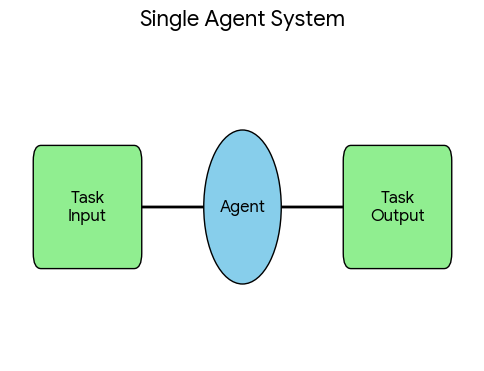
A single agent system is the simplest architecture: one agent handles the complete task from start to finish. The agent receives user input, performs reasoning, calls tools as needed, and produces the final output.
When to Use
Single agent systems work well for:
- Focused tasks - One clear objective like answering questions or completing a specific workflow
- Simple tool usage - A handful of related tools that one agent can manage effectively
- Quick responses - When latency matters and you want minimal overhead
How Marlo Tracks It
Wrap your agent logic in a single marlo.task() context. All LLM calls, tool calls, and reasoning steps are captured within that task.
Python
with marlo.task(thread_id="user-123", agent="my-agent") as task:
    task.input(user_message)

    # All your agent logic here
    # LLM calls and tool calls are captured automatically

    task.output(final_response)
TypeScript
const task = marlo.task('user-123', 'my-agent').start();
task.input(userMessage);

// All your agent logic here
// Record LLM and tool calls with task.llm() and task.tool()

task.output(finalResponse);
task.end();
What You See in the Dashboard
Each task appears as a single trace showing:
- User input that started the task
- All LLM calls with messages and token usage
- All tool invocations with inputs and outputs
- Internal reasoning steps
- Final output returned to the user
- Reward score and rationale
Learnings are generated per-agent, so your single agent develops its own guidance over time.
Example: Support Agent
A customer support agent that looks up orders and answers questions:
marlo.agent(
    name="support-agent",
    system_prompt="You help customers with order inquiries.",
    tools=[
        {"name": "lookup_order", "description": "Find order by ID", ...},
        {"name": "check_inventory", "description": "Check product stock", ...},
    ],
    mcp=[],
)

with marlo.task(thread_id=session_id, agent="support-agent") as task:
    task.input("Where is my order #12345?")

    # Agent reasons about what to do
    task.reasoning("Customer wants order status. I should look up the order.")

    # Agent calls tools
    order = lookup_order("12345")  # Tracked if using @track_tool

    # Agent generates response
    response = llm_call(...)  # Tracked if instrumented

    task.output("Your order shipped yesterday and arrives tomorrow.")
Last updated on