Orchestrator
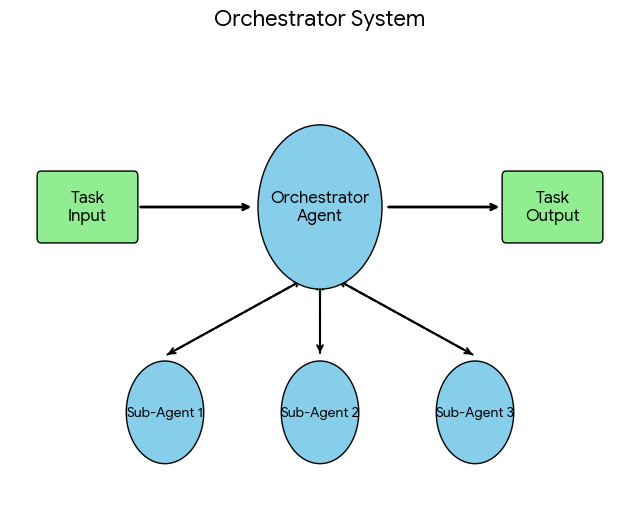
An orchestrator system has one root agent that coordinates the task and delegates work to specialized sub-agents. The orchestrator decides which sub-agent to call, collects their outputs, and produces the final response.
When to Use
Orchestrator systems work well for:
- Complex tasks - Problems that benefit from multiple specialized perspectives
- Division of labor - When different skills (research, writing, analysis) should be isolated
- Quality through specialization - Sub-agents can be optimized for narrow tasks
How Marlo Tracks It
Use task.child() to create child tasks for each sub-agent. The SDK automatically links child traces to the parent, creating a hierarchy in the dashboard.
Python
with marlo.task(thread_id=thread_id, agent="orchestrator") as parent:
    parent.input(user_request)
    parent.reasoning("I'll delegate research to the researcher agent.")

    # Delegate to child agent
    with parent.child(agent="researcher") as child:
        child.input("Find information about: " + user_request)
        # Child does its work...
        child.output(research_findings)

    # Use child's results
    parent.output("Based on research: " + research_findings)
TypeScript
const parent = marlo.task(threadId, 'orchestrator').start();
parent.input(userRequest);
parent.reasoning("I'll delegate research to the researcher agent.");

// Delegate to child agent
const child = parent.child('researcher').start();
child.input('Find information about: ' + userRequest);
// Child does its work...
child.output(researchFindings);
child.end();

// Use child's results
parent.output('Based on research: ' + researchFindings);
parent.end();
What You See in the Dashboard
The dashboard shows a hierarchical view:
📁 Task: "Research AI trends" (orchestrator)
├── 📄 Input: "What are the latest AI trends?"
├── 📝 Reasoning: "I'll delegate to researcher, then synthesize"
├── 📁 Child Task (researcher)
│   ├── 📄 Input: "Find information about AI trends"
│   ├── 🔧 Tool: web_search(...)
│   └── 📄 Output: "Found 3 sources..."
├── 📁 Child Task (writer)
│   ├── 📄 Input: "Summarize findings..."
│   └── 📄 Output: "Summary..."
└── 📄 Output: "Based on my research..."
Each agent develops its own learnings independently:
- The orchestrator learns coordination patterns
- The researcher learns search strategies
- The writer learns summarization techniques
Example: Research Assistant
# Register all agents
marlo.agent(name="orchestrator", system_prompt="You coordinate research tasks.", ...)
marlo.agent(name="researcher", system_prompt="You search and gather information.", ...)
marlo.agent(name="writer", system_prompt="You write clear summaries.", ...)

def research_topic(request: str, thread_id: str):
    with marlo.task(thread_id=thread_id, agent="orchestrator") as parent:
        parent.input(request)

        # Step 1: Research
        with parent.child(agent="researcher") as researcher:
            researcher.input("Research: " + request)
            findings = do_research(request)
            researcher.output(findings)

        # Step 2: Write summary
        with parent.child(agent="writer") as writer:
            writer.input("Summarize: " + findings)
            summary = write_summary(findings)
            writer.output(summary)

        parent.output(summary)
        return summary
Best Practices
- Register all agents before using them in tasks
- Log orchestrator reasoning to capture delegation decisions
- Keep sub-agents focused on single responsibilities
- Pass clear context to child agents about what they should do
Last updated on